
The Psynovium Study
An integrated single cell and spatial transcriptomic study of synovial inflammation in psoriatic arthritis
Project Lead: Dr Ryan Hum
Ryan is currently a Wellcome Trust 4ward North Clinical PhD Fellow and Speciality Registrar in Rheumatology and Internal Medicine within the Centre for Musculoskeletal Research, The University of Manchester. His PhD title is "An integrated single cell and spatial transcriptomic study of synovial inflammation in psoriatic arthritis".
After graduating from The University of Manchester he completed foundation training in Cheshire and was awarded an NIHR Academic Clinical Fellowship to undertake integrated academic training in Rheumatology & Internal Medicine in Manchester, UK. He was subsequently awarded a Wellcome Trust Fellowship to undertake a PhD.
His research is funded through grants and fellowships awarded by the British Society for Rheumatology (BSR), the British Psoriatic Arthritis Consortium (BritPACT), the National Psoriasis Foundation, the Wellcome Trust, the Manchester Academic Health Sciences Centre, and the National Institute for Health and Care Research Manchester Biomedical Research Centre.
Lay Abstract
Psoriatic arthritis (PsA) is a long-term condition where the body's immune system attacks the joints. PsA causes inflammation, pain, and sometimes serious health problems if not treated. It affects about 1% of people worldwide. PsA medications target the immune system to reduce inflammation, but they do not work for everyone. That is why we need more research to find better ways to treat PsA.
New technologies allow us to study PsA at a very detailed level, looking at different types of cells and how they interact. Yet, we have not fully explored how these cells behave in PsA when inflammation is active.
In this project, l will study joint tissue, fluid, and blood samples from PsA patients and compare these to samples from patients with rheumatoid arthritis (RA). I will recruit patients before treatment with biologic medications, who have inflammation in their joints detected by ultrasound. I will use the latest genomic technologies including CITE-seq and 10x Visium which is a spatial transcriptomic technology.
My goals are to figure out which specific types of cells and pathways cause inflammation in PsA and to identify new treatment types and tests to monitor disease in clinic. Understanding how these cells work together in PsA will help us find new targets for treatment and ways to track the disease's progression.
I'll do this by analysing the cells from the tissue, fluid, and blood samples to create a detailed atlas of the different cell types in PsA. This will be the most detailed map of PsA to date, and the first study to look at the location of these cells in inflamed joint tissue. I will use this new data and combine it with existing data made from patients with RA and psoriasis to figure out which cells are uniquely responsible for causing inflammation in PsA.
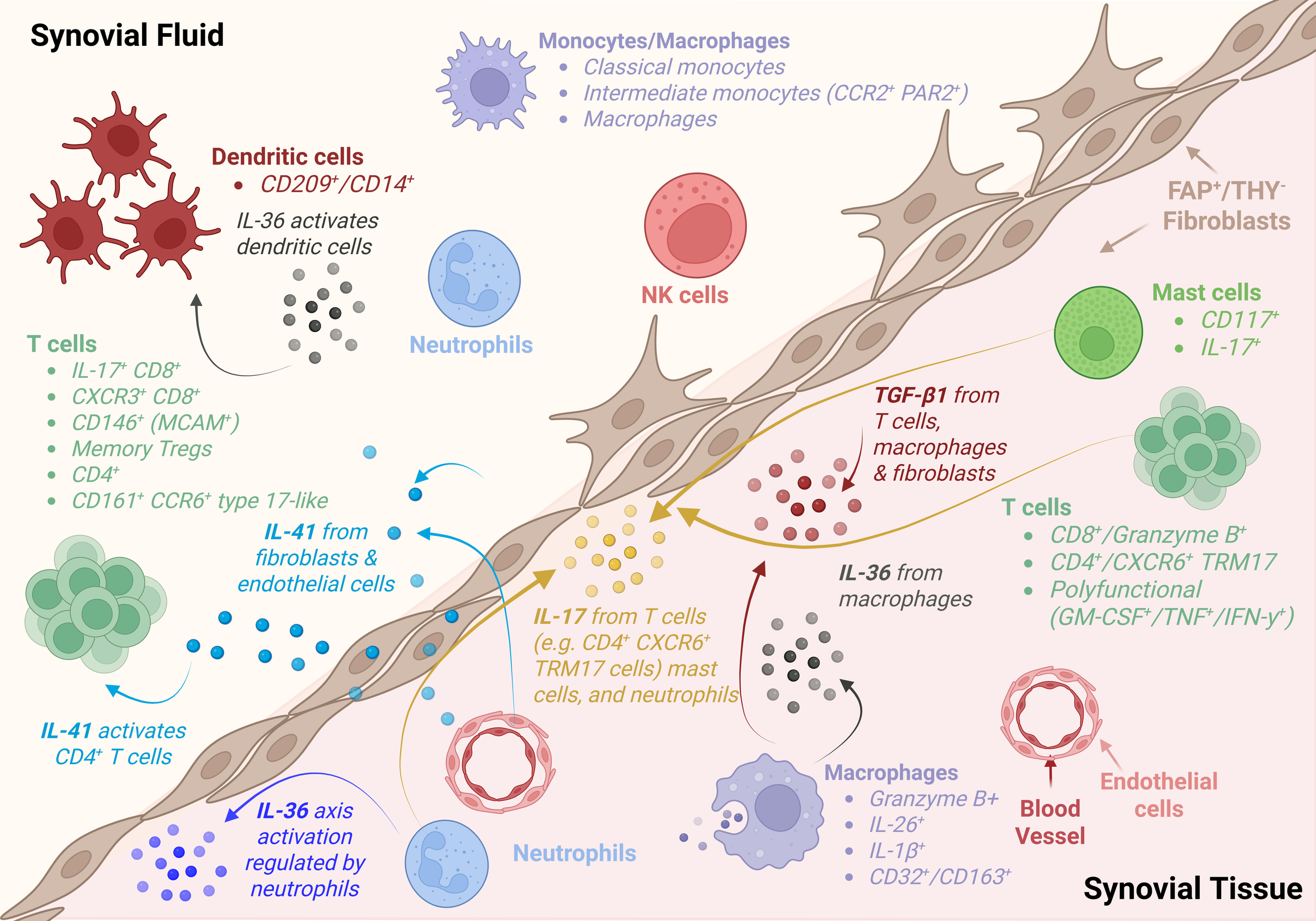
Review article published The Lancet Rheumatology
Although psoriatic arthritis and rheumatoid arthritis are both common types of inflammatory arthritis characterised by synovial inflammation, there are distinct molecular and cellular landscapes between these conditions.
In this Review, Ryan Malcolm Hum and colleagues explore how research of the synovium has advanced the understanding of psoriatic arthritis, the potential of identified cell types and cytokines as biomarkers and novel therapeutic targets, how limited sample sizes in high-dimensional studies are hindering clinical translation, and the future directions for synovial research in psoriatic arthritis.
Click here to read the full article ➡️ Link to Full Article